Apple ProRes 4444 XQ for Adobe & Avid for FCP X Zhan Pol. How to Understand Codecs - Duration. How to Install ProRes Codecs FREE for Mac and Adobe Media Encoder. Bigasoft ProRes Converter for Mac is designed for Mac users to encode or decode all types of Apple ProRes codecs including ProRes 4444, ProRes 422 (HQ), ProRes 422, ProRes 422 (LT), and ProRes 422.
[ Updated with new information about the Rec. 2020 color space, and how ProRes 4444 XQ works. ]
Today, Apple released support for a new member of the ProRes family of codecs: ProRes 4444 XQ. This is a new, very high-quality codec, specifically designed for VFX work.
WHAT IS IT?
According to a white paper released this month from Apple:
Apple ProRes 4444 XQ: The highest-quality version of Apple ProRes for 4:4:4:4 image sources (including alpha channels), with a very high data rate to preserve the detail in high-dynamic-range imagery generated by today’s highest-quality digital image sensors. Apple ProRes 4444 XQ preserves dynamic ranges several times greater than the dynamic range of Rec. 709 imagery—even against the rigors of extreme visual effects processing, in which tone-scale blacks or highlights are stretched significantly. Like standard Apple ProRes 4444, this codec supports up to 12 bits per image channel and up to 16 bits for the alpha channel. Apple ProRes 4444 XQ features a target data rate of approximately 500 Mbps for 4:4:4 sources at 1920 x 1080 and 29.97 fps.
Again, quoting from Apple’s white paper:
Traditionally, digital images have been limited to 8-bit samples. In recent years the number of professional devices and acquisition techniques supporting 10-bit and even 12-bit image samples has increased. 10-bit imagery is now often found in 4:2:2 video sources with professional digital (SDI, HD-SDI or even HDMI) outputs. 4:2:2 video sources rarely exceed 10 bits, but a growing number of 4:4:4 image sources claim 12-bit resolution, though with sensor-derived images the least significant one or two bits may have more noise than signal. 4:4:4 sources include high-end film scanners and film-like digital cameras and can include high-end computer graphics.
Apple ProRes 4444 XQ and Apple ProRes 4444 support image sources up to 12 bits and preserve alpha sample depths up to 16 bits. All Apple ProRes 422 codecs support up to 10-bit image sources, though the best 10-bit quality is obtained with the higher‑bit-rate family members—Apple ProRes 422 and Apple ProRes 422 HQ. (Note: Like Apple ProRes 4444 XQ and Apple ProRes 4444, all Apple ProRes 422 codecs can in fact accept image samples even greater than 10 bits, although such high bit depths are rarely found among 4:2:2 or 4:2:0 video sources.)
ALPHA CHANNELS
Alpha Channels store the transparency information in a clip. Unlike other members of the ProRes family, both Apple ProRes 4444 and ProRes 4444 XQ store alpha data. And, they store it in a mathematically lossless manner.
From Apple’s white paper:
Alpha values are essentially numeric data that specify how to blend, or composite, a foreground image into a background image. For this reason, Apple ProRes 4444 XQ and Apple ProRes 4444 encode alpha values exactly rather than approximately. This kind of exact encoding is called “lossless” (or sometimes “mathematically lossless”) compression. It uses different encoding techniques from those used by the Apple ProRes codec family for RGB or Y’CBCR pixel values, where approximate encoding is acceptable as long as differences from the original are not visible to the viewer and do not affect processing. The Apple ProRes 4444 XQ and Apple ProRes 4444 codecs losslessly encode alpha channel values of any bit depth up to and including 16 bits.
In summary, the Apple ProRes 4444 XQ and Apple ProRes 4444 codecs can be considered “visually lossless” for encoding the Y’CBCR or RGB pixel values intended for viewing, but “mathematically lossless” for encoding the alpha values that specify compositing. As a result, the degree of quality or fidelity is never a question for Apple ProRes 4444 alpha channels because the decoded data always matches the original perfectly.
DATA RATES

ProRes 4444 XQ is not a small file. It is designed for the highest possible quality, while still providing reduced file size when compared to an uncompressed source file.
According to Apple, both 1080i/30 and 720p/60 files require a data transfer rate of about 62 MB/sec, and use about 223 GB to store an hour of material. Other frame rates and images sizes will be somewhat different.
You can download the entire white paper from Apple here.
UPDATE: JULY 1, 2014
A reader asked about the relationship between ProRes 4444 XQ and Rec. 2020.
Apple Prores 4444 Xq Codec Download Mac Iso
Rec. 2020 is a color space while ProRes is a codec. ProRes is capable of handling a Rec. 2020 signal, since ProRes can accommodate a wide range of color spaces.
Also, wide color gamut (like Rec. 2020) is different from high dynamic range, as Rec. 2020 is designed for reproducing a wider range of colors than Rec. 709. For those people working with higher dynamic range footage, the increased data rate of ProRes 4444 XQ is beneficial for capturing the superior tonal range of HDR material like Log C. This is why ARRI is offering ProRes 4444 XQ recording in high-end configurations of the the ALEXA camera, which was announced yesterday.
UPDATE: JULY 15, 2014
Since I first wrote this article, I’ve learned more about ProRes 4444 XQ. It is principally designed for pro cameras that record High Dynamic Range (HDR) video, because the higher data rate of the format preserves the detail in these recordings. It is currently in use as a camera-codec, for example as part of the ARRI ALEXA. But it has benefits all the way through the video post production pipeline — especially for color grading and visual effects as I describe below.
ProRes 4444 XQ records color data — the red, green, and blue values in an image — with greater accuracy; that is, more decimal places. This precision is necessary when you are shooting a clip that you plan to alter with extreme color adjustments in post.
Here’s a simple analogy to illustrate the benefits of ProRes 4444 XQ. Let’s take a pixel recorded in AVCHD (an 8-bit codec) and compare it to a pixel recorded in ProRes 4444 XQ. Say the “true” source pixel value is 7.499, and you are going to apply an adjustment that effectively amplifies the value by 10x.

With lower bit-rate compression like AVCHD, the original 7.499 pixel value might be represented as 7. After the 10x effect is applied, the value becomes 70.
Apple Prores Formats
With high bit-rate compression like ProRes 4444 XQ, the original 7.499 pixel value might be 7.5. After the 10x effect is applied, the value becomes 75, which is much closer to the final value of 74.99 that represents perfect precision. Here is a summary:
AVCHD | |
| Starting pixel value | 7 |
| Error | 0.499 |
| Effect | x 10 |
| Final value | 70 |
| Error | 4.99 |
With AVCHD, the difference in starting values between 7 and 7.499 might not be noticeable. But after the effect is applied, the difference between 70 and 74.99 may become significant. With ProRes 4444 XQ, the starting value is so accurate that even after the effect is applied, the error in the final value remains very small.
Because we started with more decimal places in ProRes 4444 XQ, we ended up with more accurate color at the end. This is the benefit that shooting ProRes 4444 XQ provides – more information is recorded at the beginning to allow more flexibility in editing at the end.
As always, let me know what you think.
Larry
Posted by Candice Liu to Video Converter, Convert ProRes | Updated on Feb 23, 2019
Is there any proper ProRes converter to transcode Apple ProRes 422, ProRes 4444 on Mac/Win?
As is known to all, ProRes is a codec developed by Apple Inc., which provides an unparalleled combination of multistream, real-time editing performance, impressive image quality, and reduced storage rates. It was first introduced in 2007 with Final Cut Studio 2. Actually, ProRes is the best video format supported by FCP 7 and FCP X for video editing. After all, rendering H.264 on Final Cut Pro may more or less degrade video image quailty, but ProRes will ensure a smooth editing process with highest quality. If you care more about the video quality and the efficiency of editing, it's necessary to convert MTS, AVCHD, MKV and more videos shot by camcorders to ProRes for editing on Final Cut Pro.
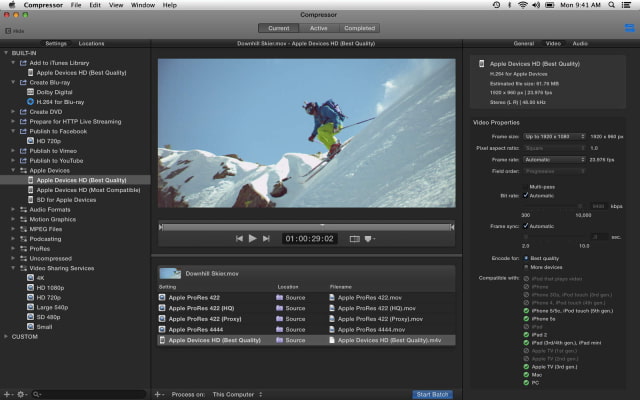
On the other hand, comparing to H.264/AVCHD, Apple ProRes delivers a crazy big size of videos, especially in ProRes 4444 XQ, ProRes 4444, ProRes 422 HQ. For example, I've been edit a 30 minutes video (less than 6GB) in Final Cut Pro, yet getting a 130GB with 26 videos after rendering ProRes finally. Lookshorrible! Worse still, PreRes videos has poor compatibility, which only supports watching on QuickTime Player and VLC currently. Thus, if you get some videos in ProRes codec and want to play them on your iPhone iPad Android devices or other media players, you need an Apple ProRes converter to convert ProRes to MP4, MOV, FLV, AVI, etc.
Comments are closed.